🔗 Paper on which the article is based
written by Mohammed Bilal Ahmed and Nicolas Perez
Introduction
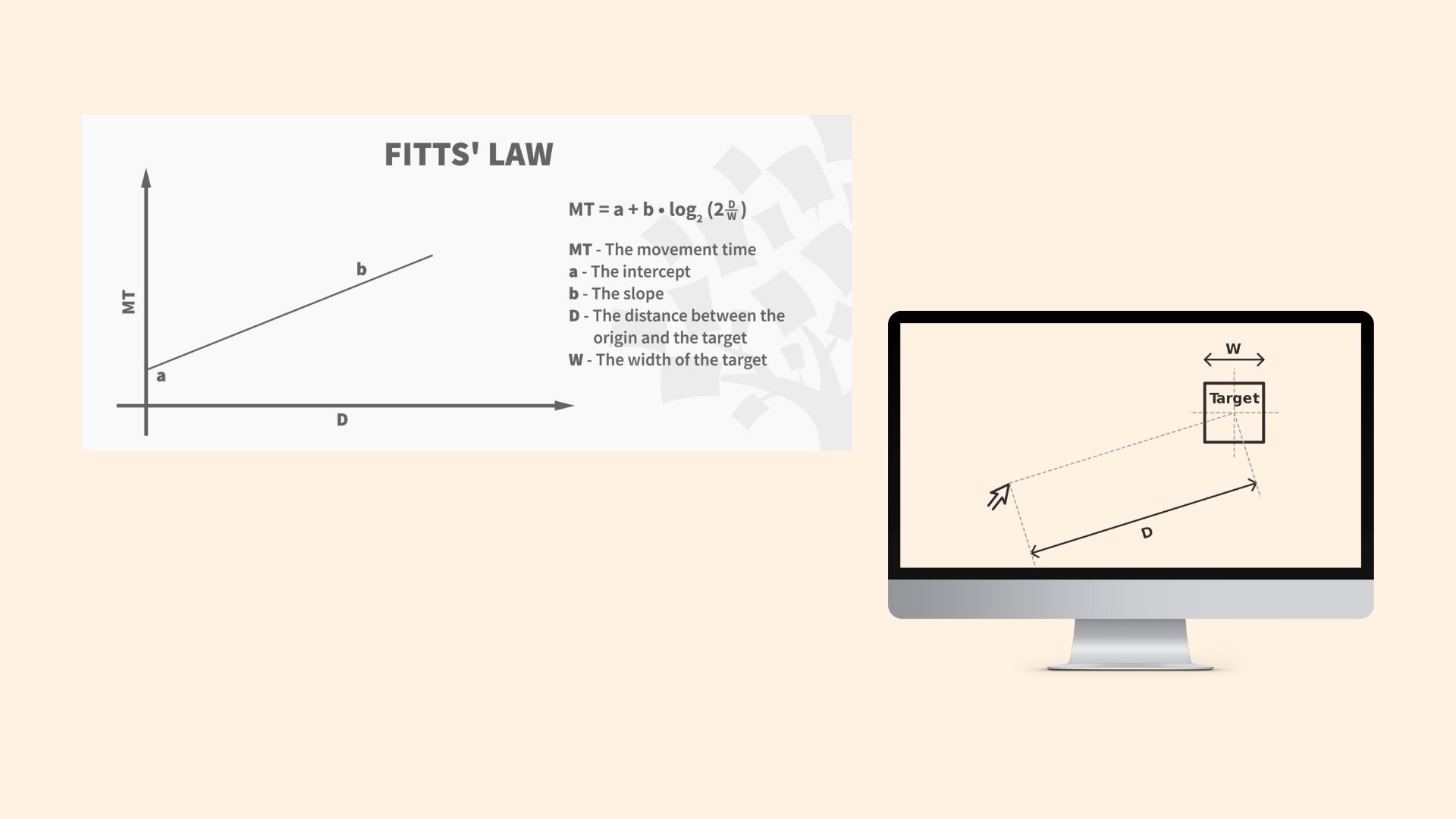
Fitts law: A speed and accuracy model of human movement developed from research in a machine system for air traffic. The goal of this paper was to use this very law and try to fit it into 2-dimensional tasks. When the authors had examine the law from this perspective. They had to consider many different factors such as the angle at which the target might be and so on. There were different formulas developed beforehand but the Shannan formula was preferred for the basis of this experiment. Different factors such as the size and shape of the model were taken into consideration when calculating the movement time(i.e., time required to touch the target)
What did the authors assess and find?
They assessed the time taken by the users to select a target at different angles. Each angle and general distance were categorized into different groups. There were twelve computer literature subjects that served as volunteers. There were 9 male and 3 female volunteers. The results from these tests were then compared. The SMALLER-OF and W’ models were very close in their movement time. While on the other hand the SMALLER-OF vs STATUS QUO and W’ vs STATUS QUO had a huge gap in their movement time. The SMALLER-OF model highlighted that Movement time depends upon pointing distance more as the target gets larger. An interesting observation under the STATUS quo model was that generally, one would expect large size letters and alphabets should have a significantly shorter time to select but then it turns out that the results or prediction did not match this. A major observation that was found was that it was difficult to compare these different models as in some such as W’ it was assumed that the subject moved towards the center of the target. Perhaps the biggest factor was comparing these different models when the parameters themselves were not the same. So the comparison did not make sense other than the final movement time.
Limitations of the paper
The paper itself talks about some of the limitations of the proposed models. While some models are easier to use, such as the Status Quo model, they can lead to inaccurate data. The other models, which account more for height and angle of approach, can be harder to apply in a more general sense, such as the smaller-of model being limited to rectangular objects. Notably what isn’t discussed as a limitation with regards to their experiment, is that the sample size for the experiment is fairly small: 12. In addition, the subjects of the study were computer-literate volunteers. However, the volunteers' backgrounds are less of a problem since the focus of the study was to fix Fitt’s law in two dimensions, since it could with certain configurations produce a “negative” difficulty value.
The contributions of the paper to the scientific community
This paper has a clear scientific contribution through its study of ways of modifying Fitt’s law into a more useful form for two-dimensional environments. Since most of our User Interfaces are two-dimensional, this is important information to know. In addition, instead of just one model, it provides and shows the result of several models and how accurate they are. It’s important that the fundamentals we rely on stay up to date as technology changes, and this paper does that for Fitt’s law to bring it to two dimensions. Work in this area should continue as User Interfaces change and grow, such as in three-dimensional environments as Virtual and Augmented Reality devices grow in popularity.